


GPT-5.2
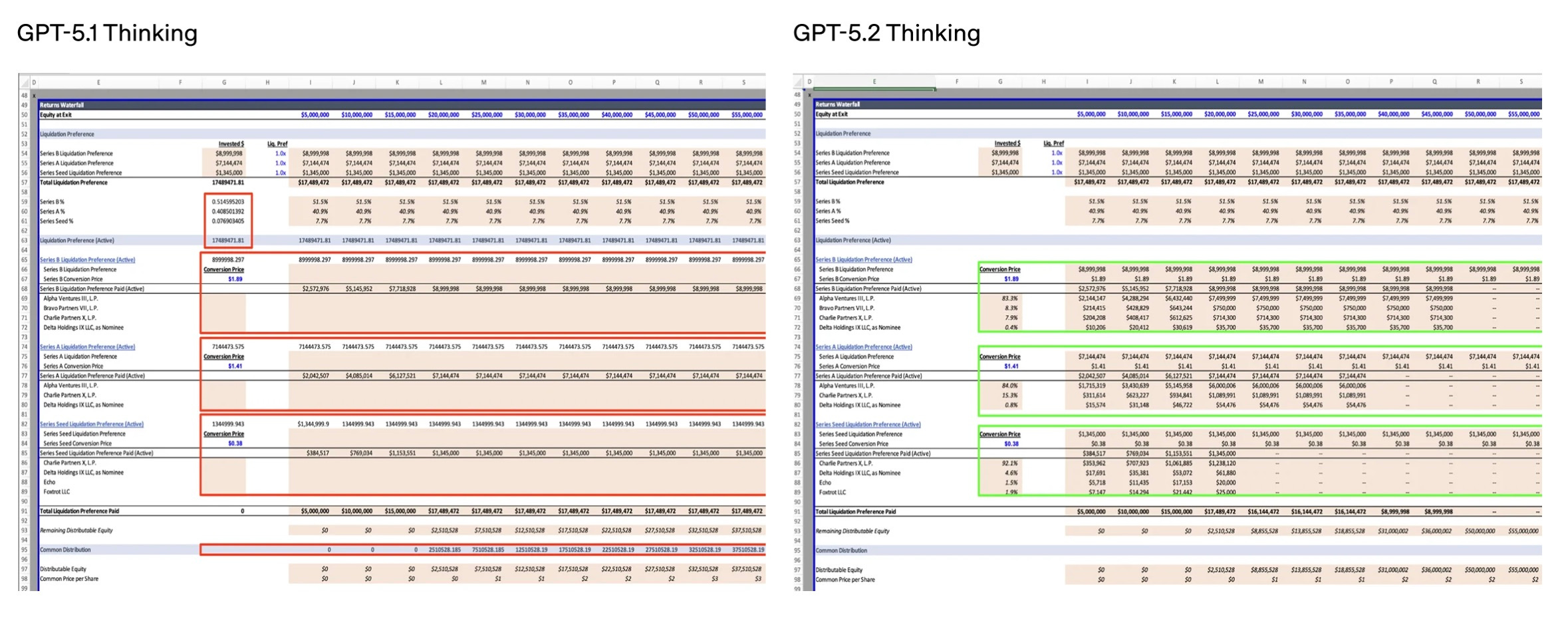
OpenAI has launched GPT-5.2, its most capable AI model yet, in the wake of the company’s internal “code red.” The new model series (comprising Instant, Thinking, and Pro variants) delivers substantial performance gains across professional tasks, particularly in knowledge work benchmarks.
Why it matters:
GPT-5.2 targets professional workflows and AI agents specifically, with claims of better performance in spreadsheets, presentations, code, and “complex, multi-step projects” - plus reduced hallucinations in its Thinking model to build trust for enterprise use.
While the capabilities are impressive, this release also signals a future where the path forward is solving real-world professional tasks rather than chasing abstract intelligence metrics - Anthropic has previously done the same, declaring that it would focus on real-world coding capability rather than benchmarks.
Ultimately, models like this take months to train and launch, but CEO Fidji Simo’s acknowledgment that “code red” resources were “helpful” is an acknowledgment that the landscape has indeed changed - OpenAI is no longer solely setting the pace for model progress.
Elsewhere in frontier models:
Runway launches GWM-1, its first world model that uses frame-by-frame prediction to simulate physics, and updates Gen 4.5 to add native audio.
Mistral releases Devstral 2, a 123B-parameter AI coding model requiring at least four H100 GPUs, alongside Devstral Small, a 24B-parameter model for local use.
Chinese AI startup Z.ai debuts GLM-4.6V, open-weight vision models with native function calling available in 106B- and 9B-parameter versions.
And Anthropic, OpenAI, Block, Google, AWS, Microsoft, and others launch the Agentic AI Foundation to build open-source agent standards under the Linux Foundation.

Federal Override
The Trump administration is aggressively reshaping AI policy with a dual strategy: domestically restricting states’ ability to regulate artificial intelligence companies while internationally allowing tech giants like Nvidia to sell advanced chips to China in exchange for a 25% revenue cut to the US government.
Between the lines:
President Trump signed an executive order threatening to withhold $42 billion in broadband funding from states with AI regulations his administration deems too restrictive, as well as establishing an “AI Litigation Task Force” under Attorney General Pam Bondi to actively challenge state AI laws.
The order targets states like Colorado (anti-discrimination provisions) and California (catastrophic risk mitigation requirements), framing consumer protections as “ideological bias” that could stifle innovation and America’s competitiveness against China.
President Trump also announced that Nvidia can sell its H200 AI chips to “approved customers” in China, but only if the US government receives a 25% cut of the revenue. The H200s are something of a middle ground - they’re nearly six times more powerful than chips currently allowed in China but significantly behind the Blackwell chips US companies are using.
The gamble is that the US can maintain its AI lead through a deregulated domestic market and controlled chip exports that generate revenue, but critics see a “lawless Wild West” at home and a “colossal national security failure” abroad that could ultimately strengthen China’s military and indigenous chip industry.
Elsewhere in AI geopolitics:
New US OMB guidance states that LLMs procured by federal agencies must comply with two “unbiased AI principles“: “truth-seeking” and “ideological neutrality”.
The NY governor is reportedly considering a rewrite of the RAISE Act, the AI bill that recently passed the NY legislature, with text copied verbatim from California’s SB 53, after signing bills requiring ads to disclose AI-generated performers and mandating consent of heirs to use a deceased person’s likeness commercially.
US state AGs sent a letter to Meta, Microsoft, Google, Apple, and nine others, warning that their chatbots’ “delusional outputs” could be violating state laws.
The US DOJ detains two men for allegedly violating export controls by trying to smuggle $160M+ of Nvidia chips to China; a third man pleads guilty.
And the US DOD says it has chosen Google’s Gemini for Government to power its new GenAI.mil platform for the US military, as part of a $200M contract from July.
Elsewhere in AI infrastructure:
Broadcom CEO Hock Tan reveals that Anthropic placed a $10B order for Google’s Ironwood TPU racks in Q3 and an additional $11B order in Q4.
Blue Origin has worked for over a year on tech for orbital AI data centers, while SpaceX plans to use upgraded Starlink satellites for AI computing payloads.
Nvidia says it hasn’t seen substantiation of chip smuggling via data centers outside of China after The Information’s DeepSeek story.
Big Tech’s AI data center plans face a power crunch that could deflate the AI “bubble” as they need an estimated 44GW of additional capacity by 2028.
And Amazon and Microsoft plan to invest $35B+ in India and $17.5B in India respectively, over the next four years on AI and cloud computing.

Creative Licensing
Disney and OpenAI have struck a $1 billion deal that will allow Sora users to create and share short videos featuring over 200 Disney, Marvel, Pixar, and Star Wars characters - marking the first major licensing partnership between a legacy entertainment giant and a generative AI company.
Between the lines:
The three-year agreement positions Disney as both a content licensor and major OpenAI customer, with plans to integrate ChatGPT across its operations and use OpenAI’s APIs to build new Disney+ experiences, while curated fan-made Sora videos will stream on the platform starting in early 2026.
The deal’s carefully defined boundaries reveal Hollywood’s red lines: no talent likenesses, no character voices, and OpenAI must allow Disney to “set and evolve guardrails over time.” Disney CEO Bob Iger is framing this as inevitable adaptation rather than capitulation, arguing that “no human generation has ever stood in the way of technological advance.”
Ultimately, this is as much about strategic positioning in the AI race as it is about licensing revenue - Disney also this week sent a cease-and-desist letter to Google, accusing the tech giant of “massive scale” copyright infringement by training AI models on Disney’s characters - following similar actions against Meta, Character.AI, Midjourney, and Minimax.
Elsewhere in OpenAI:
Sam Altman reflects on OpenAI’s 10th anniversary, highlighting a decade of breakthroughs and the path toward AGI that benefits all of humanity.
Fidji Simo says ChatGPT’s “adult mode” is expected to launch in Q1 2026 once the company improves its age prediction capabilities.
OpenAI and Instacart launched a grocery shopping experience inside ChatGPT that lets customers brainstorm meal ideas and check out directly.
The company warns that its upcoming frontier AI models are likely to pose a “high” cybersecurity risk as their cyber capabilities accelerate.
Slack CEO Denise Dresser is leaving the company to join OpenAI as its Chief Revenue Officer after serving in the role since November 2023.
And Sam Altman said OpenAI plans to end its “code red” after releasing a model in January 2026 with improved image generation, speed, and personality.
Elsewhere in AI anxiety:
Stanford researchers developed AI hacking bot Artemis, which surpassed nine out of 10 penetration testers by rapidly finding bugs in the university’s network.
A study found 15 TikTok accounts posting AI videos of sexualized underage girls have nearly 300K followers, with TikTok saying that 14 of the accounts don’t violate its rules.
The International Committee of the Red Cross warned that AI models are fabricating research papers, journals, and archives.
The New York Times sued Perplexity, claiming the AI startup violated its copyrights and kept using its content despite repeated demands over the past 18 months.
A developer who accidentally found CSAM in AI training data was banned by Google for reporting it.
And McDonald’s Netherlands pulled an AI-generated Christmas ad after social media backlash.

Google has a lot going on
The headline this week was GPT-5.2, but Google is keeping up with its nonstop launch cadence.
What’s the latest:
Disco, a Gemini 3-powered experiment that suggests and creates GenTabs, web apps based on the user’s open browser tabs and Gemini chat history.
An enhanced Gemini Deep Research agent accessible to developers via its new Interactions API, along with a new DeepSearchQA benchmark.
Fully managed, remote MCP servers to help developers connect AI agents to services such as Maps, BigQuery, Compute Engine, and Kubernetes Engine.
Gemini 3 Pro sets new vision AI benchmark records, including in complex visual reasoning, beating Claude Opus 4.5 and GPT-5.1 in some categories.
Amin Vahdat, who leads the company’s AI and infrastructure team, to chief technologist for AI infrastructure, reporting to Sundar Pichai.
A cheaper AI Plus plan in India, costing ~$2.21 per month for the first six months and ~$4.44 thereafter, to compete with ChatGPT Go.
Google has told advertisers that it plans to bring ads to Gemini in 2026; Google’s VP of Global Ads says there are no plans for ads in the Gemini app.
DeepMind plans to open its first “automated science laboratory” in the UK in 2026, focused on using AI tools to develop new materials for chips and more.
The company details the steps it is taking to secure Chrome’s upcoming agentic browsing features, like a “User Alignment Critic” model that vets each AI agent action.
And Google details its plans for two different categories of AI-powered smart glasses coming as soon as 2026: one with in-lens displays and one that’s audio-focused.
Elsewhere in the FAANG free-for-all:
Meta’s new AI model, codenamed Avocado, may launch in spring 2026 as a “closed” model trained using Google’s Gemma, OpenAI’s gpt-oss, and Qwen.
Tensions have emerged between Meta’s TBD Lab and longtime lieutenants to Mark Zuckerberg over computing resources, company goals, and priorities.
Microsoft Research, Providence, and UW developed the GigaTIME AI model, which can analyze tumors in a fraction of the time and cost of existing methods.
And Meta acquires Limitless, which makes a pendant-style AI wearable that records and transcribes real-world conversations.
Things happen
xAI partners with El Salvador to deploy Grok across 5,000+ public schools. Time names “the Architects of AI“ as its 2025 Person of the Year. Cursor launches Visual Editor, a vibe-coding product for designers. How the Model Context Protocol became an industry standard. An overview of AI in 2025, including arguments for and against above-trend capabilities growth. AI browsers are forcing web developers to rethink whether they’re designing for humans or crawlers. The US FDA qualifies the first AI drug development tool to help assess a fatty liver disease. How Chinese companies hire Kenyan AI annotators via opaque middleman networks to avoid accountability. Inside the creation of AI actress Tilly Norwood, which took 2,000 iterations. Several companies are “refounding” to add AI features. Reasoning models now represent over half of all usage, an analysis of 100T+ tokens shows. AGI may never emerge because the concept ignores physical realities of computation. ChatGPT was 2025’s most downloaded free app in the US App Store.

5.2 benchmarks are nuts. Very much enjoying comparing it to other models
Thank you Charlie for your great posts this year!